Stimulus bill enabled billions in waste, exploitation of employees
...The largest government infusion of cash into the U.S. economy in generations – the 2009 stimulus – was riddled with a massive labor scheme that harmed workers and cheated unsuspecting American taxpayers.
At the time, government regulators watched as money slipped out the door and into the hands of companies that rob state and federal treasuries of billions of dollars each year on stimulus projects and other construction jobs across the country, a yearlong McClatchy investigation found.
A review of public records in 28 states uncovered widespread cheating by construction companies that listed workers as contractors instead of employees in order to beat competitors and cut costs. The federal government, while cracking down on the practice in private industry, let it happen in stimulus projects in the rush to pump money into the economy at a time of crisis.
Companies across the country avoided state and federal taxes and undercut law-abiding competitors. They exploited workers desperate for jobs, depriving them of unemployment benefits and often workers’ compensation insurance.
Exactly how much tax revenue was forfeited on stimulus projects isn’t clear. This is: The government enabled businesses bent on breaking the rules. Regulators squandered the chance to right a rogue industry by forcing companies’ hands on government jobs....
Showing posts with label bailout. Show all posts
Showing posts with label bailout. Show all posts
Sunday, December 15, 2013
U.S. Sells Off Last of Its General Motors Stock, at $10.5 Billion Loss
U.S. taxpayers no longer own any of automaker General Motors. The Treasury sold the last of its remaining 31.1 million GM shares today.
The taxpayer loss on the GM bailout finishes at $10.5 billion. The Treasury department said it recovered $39 billion from selling its GM stock, and had put $49.5 billion of taxpayer money into the GM bailout.......
U.S. taxpayers no longer own any of automaker General Motors. The Treasury sold the last of its remaining 31.1 million GM shares today.
The taxpayer loss on the GM bailout finishes at $10.5 billion. The Treasury department said it recovered $39 billion from selling its GM stock, and had put $49.5 billion of taxpayer money into the GM bailout.......

Saturday, November 02, 2013
US swallowed $9.7 billion loss on General Motors bailout
The U.S. government has booked a loss of $9.7 billion on the nearly $50 billion bailout of U.S. automaker General Motors, according to a quarterly report to Congress on Tuesday.
In 2009, the U.S.Treasury extended $49.5 billion in loans to GM in exchange for $2.1 billion in preferred stock and a 60.8 percent equity stake.
Treasury has since whittled down its stake in GM through a series of stock sales. Those sales have all taken place below the price Treasury needed to break even on its GM investment, resulting in the loss, according to Tuesday's report from the Special Inspector General overseeing the $700 billion Troubled Asset Relief Program....
The U.S. government has booked a loss of $9.7 billion on the nearly $50 billion bailout of U.S. automaker General Motors, according to a quarterly report to Congress on Tuesday.
In 2009, the U.S.Treasury extended $49.5 billion in loans to GM in exchange for $2.1 billion in preferred stock and a 60.8 percent equity stake.
Treasury has since whittled down its stake in GM through a series of stock sales. Those sales have all taken place below the price Treasury needed to break even on its GM investment, resulting in the loss, according to Tuesday's report from the Special Inspector General overseeing the $700 billion Troubled Asset Relief Program....
Sunday, September 22, 2013
Washington Sees Incomes Soar as Most of U.S. Declines
...The income of the typical D.C. household rose 23.3% between 2000 and 2012 to an inflation-adjusted $66,583, according to the Census Bureau’s American Community Survey, its most comprehensive snapshot of America’s demographic, social and economic trends. During this period, median household incomes for the nation as a whole dropped 6.6% — from $55,030 to $51,371. The state of Mississippi, which had one of the biggest declines, dropped 15% to $37,095: Nearly one in three people there have an income that is near the poverty line.
The Washington, D.C. metro area — which includes the surrounding suburbs in Maryland, Virginia and West Virginia — has it even better, with a median household income of $88,233 that ranks highest among the U.S.’s 25 most populous metro areas. Tampa, Florida’s median income, by contrast, is under $45,000....
Chart of the Day: Median income in DC vs the rest of us
...From the mid-1980s to around 2007, the median household income rise in DC remained pretty closely linked to that of the nation as a whole. Anyone remember what happened in 2007, besides the economic slowdown that would turn into the Great Recession? Democrats took control of Congress and federal spending shot upward ever since. And at least according to the Fed, that disparity is actually accelerating, at least to 2012, with DC median income skyrocketing while the rest of us stagnate....
...The income of the typical D.C. household rose 23.3% between 2000 and 2012 to an inflation-adjusted $66,583, according to the Census Bureau’s American Community Survey, its most comprehensive snapshot of America’s demographic, social and economic trends. During this period, median household incomes for the nation as a whole dropped 6.6% — from $55,030 to $51,371. The state of Mississippi, which had one of the biggest declines, dropped 15% to $37,095: Nearly one in three people there have an income that is near the poverty line.
The Washington, D.C. metro area — which includes the surrounding suburbs in Maryland, Virginia and West Virginia — has it even better, with a median household income of $88,233 that ranks highest among the U.S.’s 25 most populous metro areas. Tampa, Florida’s median income, by contrast, is under $45,000....
Chart of the Day: Median income in DC vs the rest of us
...From the mid-1980s to around 2007, the median household income rise in DC remained pretty closely linked to that of the nation as a whole. Anyone remember what happened in 2007, besides the economic slowdown that would turn into the Great Recession? Democrats took control of Congress and federal spending shot upward ever since. And at least according to the Fed, that disparity is actually accelerating, at least to 2012, with DC median income skyrocketing while the rest of us stagnate....
Sunday, July 21, 2013
Detroit Court Case Presents an Impossible Choice
...Detroit’s situation seems almost unprecedented, and it’s not clear how the city can best respond to it. The unions’ biggest problem is that Detroit simply cannot pay their pension claims without destroying city services. Detroit doesn’t have the money to provide even minimal services to its current population while paying off the large numbers of retired workers, many of whom hail from times when the city was larger and richer.
Because there is no money, there is no solution that gives the unions the relief they seek. Total obedience to the state constitutional mandate might not be possible, and that’s a problem. The government can pass a law saying that everyone has a constitutional right to a free trip to the moon, but if it doesn’t build the spacecraft that can get you there the right is void....
...However the courts eventually decide, decades of misgovernance, the criminal corruption of the Democratic Party in Detroit, and the depraved indifference of politicians at every level as crooks and hacks conspired together to loot and wreck a great American city have brought us to a place where Detroit’s problems seem almost beyond solution. The saddest part of this story is that there is still much, much more pain to come for a lot of people. Both the residents of current day Detroit and the cops, teachers, firefighters and others who trusted in the promises of Detroit politicians and union officials face a world of hurt...
...Detroit’s situation seems almost unprecedented, and it’s not clear how the city can best respond to it. The unions’ biggest problem is that Detroit simply cannot pay their pension claims without destroying city services. Detroit doesn’t have the money to provide even minimal services to its current population while paying off the large numbers of retired workers, many of whom hail from times when the city was larger and richer.
Because there is no money, there is no solution that gives the unions the relief they seek. Total obedience to the state constitutional mandate might not be possible, and that’s a problem. The government can pass a law saying that everyone has a constitutional right to a free trip to the moon, but if it doesn’t build the spacecraft that can get you there the right is void....
...However the courts eventually decide, decades of misgovernance, the criminal corruption of the Democratic Party in Detroit, and the depraved indifference of politicians at every level as crooks and hacks conspired together to loot and wreck a great American city have brought us to a place where Detroit’s problems seem almost beyond solution. The saddest part of this story is that there is still much, much more pain to come for a lot of people. Both the residents of current day Detroit and the cops, teachers, firefighters and others who trusted in the promises of Detroit politicians and union officials face a world of hurt...
Michigan judge halts Detroit bankruptcy because it dishonors Obama
...Aquilina, who granted the restraining order, clearly was irked.
Prior to her ruling on Friday, she criticized the Snyder administration and Attorney General’s Office for what appeared to be hasty action to outflank pension board attorneys.
“It’s cheating, sir, and it’s cheating good people who work,” the judge told assistant Attorney General Brian Devlin. “It’s also not honoring the (United States) president, who took (Detroit’s auto companies) out of bankruptcy.”
Aquilina said she would make sure President Obama got a copy of her order.
“I know he’s watching this,” she said, predicting the president ultimately will have to take action to make sure existing pension commitments are honored....
...She also ordered that a copy of her declaratory judgment be sent to President Barack Obama, saying he “bailed out Detroit” and may want to look into the pension issue....
Judge Rules That Detroit's Bankruptcy Is Unconstitutional, Ruling That It "Dishonors" Obama
... But that itself would be unconstitutional -- that would give Detroit voters the right to vote themselves the wealth of Michigan taxpayers.
Which seems to be precisely what the judge is saying -- Detroit spent money it didn't have, and spent itself into the grave, and now innocent taxpayers are required to make good on its contracts, despite not being parties to those contracts and despite not being under the sovereign political authority of Detroit.
...Aquilina, who granted the restraining order, clearly was irked.
Prior to her ruling on Friday, she criticized the Snyder administration and Attorney General’s Office for what appeared to be hasty action to outflank pension board attorneys.
“It’s cheating, sir, and it’s cheating good people who work,” the judge told assistant Attorney General Brian Devlin. “It’s also not honoring the (United States) president, who took (Detroit’s auto companies) out of bankruptcy.”
Aquilina said she would make sure President Obama got a copy of her order.
“I know he’s watching this,” she said, predicting the president ultimately will have to take action to make sure existing pension commitments are honored....
...She also ordered that a copy of her declaratory judgment be sent to President Barack Obama, saying he “bailed out Detroit” and may want to look into the pension issue....
Judge Rules That Detroit's Bankruptcy Is Unconstitutional, Ruling That It "Dishonors" Obama
... But that itself would be unconstitutional -- that would give Detroit voters the right to vote themselves the wealth of Michigan taxpayers.
Which seems to be precisely what the judge is saying -- Detroit spent money it didn't have, and spent itself into the grave, and now innocent taxpayers are required to make good on its contracts, despite not being parties to those contracts and despite not being under the sovereign political authority of Detroit.
Sunday, May 05, 2013
Sunday, March 24, 2013
Some Sunday Links
Newsbytes: Climate Scientists Turn Skeptical As Climate Predictions Fail
The Mail on Sunday today presents irrefutable evidence that official predictions of global climate warming have been catastrophically flawed.The graph on this page blows apart the ‘scientific basis’ for Britain reshaping its entire economy and spending billions in taxes and subsidies in order to cut emissions of greenhouse gases. The graph shows in incontrovertible detail how the speed of global warming has been massively overestimated....
Climategate 3.0: Media only concerned with number of scientists on warmist list for Kyoto; ‘No one is going to check…PhDs’
Distribution for Endorsements –
I am very strongly in favor of as wide and rapid a distribution as possible for endorsements. I think the only thing that counts is numbers. The media is going to say “1000 scientists signed” or “1500 signed”. No one is going to check if it is 600 with PhDs versus 2000 without. They will mention the prominent ones, but that is a different story.
Conclusion — Forget the screening, forget asking them about their last publication (most will ignore you.) Get those names!
It Begins: Confiscation of Private Funds by Government Desperate for Cash
...The surprise decision by euro zone leaders to part-fund a bailout of Cyprus by taxing bank deposits sent shockwaves through financial markets on Monday, with shares and the bonds of struggling euro zone governments tumbling.
The bloc struck a deal on Saturday to hand Cyprus rescue loans worth 10 billion euros ($13 billion), but defied warnings - including from the European Central Bank - and imposed a levy that would see those with cash in the island's banks lose between 6.75 and 9.9 percent of their money. The initial response of investors was unambiguous. Shares lurched lower, the euro fell to a new three-month low, while safe-haven assets such as gold and German government bonds jumped. The cost of insuring the debt of even high-quality European banks against default also rose sharply with analysts citing fears the decision could spark contagion across peripheral regions with the potential for widespread outflows of deposits.
"If I were a saver, certainly in Spain or maybe Italy, I think I'd be looking askance at these measures and think this could yet happen to me," Peter Dixon, global financial economist at Commerzbank said....
...The U.S. Consumer Financial Protection Bureau is weighing whether it should take on a role in helping Americans manage the $19.4 trillion they have put into retirement savings, a move that would be the agency’s first foray into consumer investments. “That’s one of the things we’ve been exploring and are interested in in terms of whether and what authority we have,” bureau director Richard Cordray said in an interview. He didn’t provide additional details.
The bureau’s core concern is that many Americans, notably those from the retiring Baby Boom generation, may fall prey to financial scams, according to three people briefed on the CFPB’s deliberations who asked not to be named because the matter is still under discussion.
The retirement savings business in the U.S. is dominated by a group of companies that handle record-keeping and management of investments in tax-advantaged vehicles like 401(k) plans and individual retirement accounts. The group includes Fidelity Investments, JPMorgan Chase & Co. (JPM), Charles Schwab Corp. (SCHW) and T. Rowe Price Group Inc. (TROW) Americans held $19.4 trillion in retirement assets as of Sept. 30, 2012, according to the Investment Company Institute, an industry association; about $3.5 trillion of that was in 401(k) plans....
... The $19.4 trillion sitting in personal retirement accounts like the 401K may be too tempting an apple for a government that is quite broke, both monetarily and morally. The U.S. Consumer Financial Protection Bureau director Richard Cordray recently mentioned these accounts in a recent interview, stating “That’s one of the things we’ve been exploring and are interested in, in terms of whether and what authority we have.” This agency, created by the 2010 Dodd-Frank-Act, is very concerned about how safe your retirement savings are. They are apparently concerned that retiring baby boomers may become victims of financial scams. If the government takes control of retirement accounts, it will not be called “nationalization.” There will most likely be an indecipherable document that provides an opt-out option (initially), but why would you want to do that? The US government only wants to ensure the safety of your retirement funds; they did after all create a new bureaucracy for that specific purpose. And what could be a safer investment than US bonds?...
Dad says Facebook photo of son with gun brought cops to house
...Moore insisted that he wouldn't open the safe where his guns are kept-- as no warrant was allegedly presented to him -- and that a lady from the Department of Youth and Family Services refused to identify herself.
The Associated Press says that neither the department nor the police were prepared to comment on the alleged visitation and its purpose.
Moore said none of his visitors had actually seen the photo. He alleges they had merely received a phone call reporting its details.
The rifle was reportedly Josh Moore's 11th birthday gift. ...
UK downplays climate change in school curriculum
...The proposed curriculum has stoked fears among climate activists and scientists who argue that teaching climate change in schools has helped young people become ardent supporters of government policies and local actions to tackle climate change....
The Mail on Sunday today presents irrefutable evidence that official predictions of global climate warming have been catastrophically flawed.The graph on this page blows apart the ‘scientific basis’ for Britain reshaping its entire economy and spending billions in taxes and subsidies in order to cut emissions of greenhouse gases. The graph shows in incontrovertible detail how the speed of global warming has been massively overestimated....
Climategate 3.0: Media only concerned with number of scientists on warmist list for Kyoto; ‘No one is going to check…PhDs’
Distribution for Endorsements –
I am very strongly in favor of as wide and rapid a distribution as possible for endorsements. I think the only thing that counts is numbers. The media is going to say “1000 scientists signed” or “1500 signed”. No one is going to check if it is 600 with PhDs versus 2000 without. They will mention the prominent ones, but that is a different story.
Conclusion — Forget the screening, forget asking them about their last publication (most will ignore you.) Get those names!
It Begins: Confiscation of Private Funds by Government Desperate for Cash
...The surprise decision by euro zone leaders to part-fund a bailout of Cyprus by taxing bank deposits sent shockwaves through financial markets on Monday, with shares and the bonds of struggling euro zone governments tumbling.
The bloc struck a deal on Saturday to hand Cyprus rescue loans worth 10 billion euros ($13 billion), but defied warnings - including from the European Central Bank - and imposed a levy that would see those with cash in the island's banks lose between 6.75 and 9.9 percent of their money. The initial response of investors was unambiguous. Shares lurched lower, the euro fell to a new three-month low, while safe-haven assets such as gold and German government bonds jumped. The cost of insuring the debt of even high-quality European banks against default also rose sharply with analysts citing fears the decision could spark contagion across peripheral regions with the potential for widespread outflows of deposits.
"If I were a saver, certainly in Spain or maybe Italy, I think I'd be looking askance at these measures and think this could yet happen to me," Peter Dixon, global financial economist at Commerzbank said....
...The U.S. Consumer Financial Protection Bureau is weighing whether it should take on a role in helping Americans manage the $19.4 trillion they have put into retirement savings, a move that would be the agency’s first foray into consumer investments. “That’s one of the things we’ve been exploring and are interested in in terms of whether and what authority we have,” bureau director Richard Cordray said in an interview. He didn’t provide additional details.
The bureau’s core concern is that many Americans, notably those from the retiring Baby Boom generation, may fall prey to financial scams, according to three people briefed on the CFPB’s deliberations who asked not to be named because the matter is still under discussion.
The retirement savings business in the U.S. is dominated by a group of companies that handle record-keeping and management of investments in tax-advantaged vehicles like 401(k) plans and individual retirement accounts. The group includes Fidelity Investments, JPMorgan Chase & Co. (JPM), Charles Schwab Corp. (SCHW) and T. Rowe Price Group Inc. (TROW) Americans held $19.4 trillion in retirement assets as of Sept. 30, 2012, according to the Investment Company Institute, an industry association; about $3.5 trillion of that was in 401(k) plans....
... The $19.4 trillion sitting in personal retirement accounts like the 401K may be too tempting an apple for a government that is quite broke, both monetarily and morally. The U.S. Consumer Financial Protection Bureau director Richard Cordray recently mentioned these accounts in a recent interview, stating “That’s one of the things we’ve been exploring and are interested in, in terms of whether and what authority we have.” This agency, created by the 2010 Dodd-Frank-Act, is very concerned about how safe your retirement savings are. They are apparently concerned that retiring baby boomers may become victims of financial scams. If the government takes control of retirement accounts, it will not be called “nationalization.” There will most likely be an indecipherable document that provides an opt-out option (initially), but why would you want to do that? The US government only wants to ensure the safety of your retirement funds; they did after all create a new bureaucracy for that specific purpose. And what could be a safer investment than US bonds?...
Dad says Facebook photo of son with gun brought cops to house
...Moore insisted that he wouldn't open the safe where his guns are kept-- as no warrant was allegedly presented to him -- and that a lady from the Department of Youth and Family Services refused to identify herself.
The Associated Press says that neither the department nor the police were prepared to comment on the alleged visitation and its purpose.
Moore said none of his visitors had actually seen the photo. He alleges they had merely received a phone call reporting its details.
The rifle was reportedly Josh Moore's 11th birthday gift. ...
UK downplays climate change in school curriculum
...The proposed curriculum has stoked fears among climate activists and scientists who argue that teaching climate change in schools has helped young people become ardent supporters of government policies and local actions to tackle climate change....
Sunday, August 19, 2012
Emails: Geithner, Treasury drove cutoff of non-union Delphi workers’ pensions
Emails obtained by The Daily Caller show that the U.S. Treasury Department, led by Timothy Geithner, was the driving force behind terminating the pensions of 20,000 salaried retirees at the Delphi auto parts manufacturing company.
The move, made in 2009 while the Obama administration implemented its auto bailout plan, appears to have been made solely because those retirees were not members of labor unions.
The internal government emails contradict sworn testimony, in federal court and before Congress, given by several Obama administration figures. They also indicate that the administration misled lawmakers and the courts about the sequence of events surrounding the termination of those non-union pensions, and that administration figures violated federal law....
Emails obtained by The Daily Caller show that the U.S. Treasury Department, led by Timothy Geithner, was the driving force behind terminating the pensions of 20,000 salaried retirees at the Delphi auto parts manufacturing company.
The move, made in 2009 while the Obama administration implemented its auto bailout plan, appears to have been made solely because those retirees were not members of labor unions.
The internal government emails contradict sworn testimony, in federal court and before Congress, given by several Obama administration figures. They also indicate that the administration misled lawmakers and the courts about the sequence of events surrounding the termination of those non-union pensions, and that administration figures violated federal law....
GM Ramps Up Risky Subprime Auto Loans To Drive Sales
...The automaker is relying increasingly on subprime loans, 10-Q financial reports shows.
Potential borrowers of car loans are rated on FICO scores that range from 300 to 850. Anything under 660 is generally deemed subprime.
Subprime Key Driver
GM Financial auto loans to customers with FICO scores below 660 rose from 87% of total loans in Q4 2010 to 93% in Q1 2012.
The worse the FICO score, the bigger the increase. From Q4 2010 to Q1 2012, GM Financial loans to customers with the worst FICO scores — below 540 — shot up 79% to more than $2.3 billion. The second worst category, 540-599, rose 28% from about $3.4 billion to $4.3 billion....
Prime loans, those above 660, dropped 42% to $676 million.
General Motors Is Headed For Bankruptcy -- Again
...Right now, the federal government owns 500,000,000 shares of GM, or about 26% of the company. It would need to get about $53.00/share for these to break even on the bailout, but the stock closed at only $20.21/share on Tuesday. This left the government holding $10.1 billion worth of stock, and sitting on an unrealized loss of $16.4 billion.
Right now, the government’s GM stock is worth about 39% less than it was on November 17, 2010, when the company went public at $33.00/share. However, during the intervening time, the Dow Jones Industrial Average has risen by almost 20%, so GM shares have lost 49% of their value relative to the Dow....
...However, additional insight can be obtained by looking at how GM’s CEO, Dan Akerson (63), stacks up against Professor Doctor Martin Winterkorn (65), the man handpicked by Ferdinand Piech in 2007 to be his replacement as CEO of Volkswagen AG.
Akerson has an engineering degree, but he also has a Master’s Degree in Economics, and his first big job was as CFO of MCI. Akerson was CEO of General Instrument, and then of Nextel, and then of XO Communications, which went bankrupt in June 2002. He joined the private equity firm, the Carlyle Group, in 2003.
Akerson got his first job in the automobile industry when he was named CEO of GM in late 2010. Recently, he has been hiring and firing top GM executives at an alarming pace, and he is understood to be working on a major reorganization of the company. Akerson recently gave a televised speech to GM employees on the need for “integrity”....
...The automaker is relying increasingly on subprime loans, 10-Q financial reports shows.
Potential borrowers of car loans are rated on FICO scores that range from 300 to 850. Anything under 660 is generally deemed subprime.
Subprime Key Driver
GM Financial auto loans to customers with FICO scores below 660 rose from 87% of total loans in Q4 2010 to 93% in Q1 2012.
The worse the FICO score, the bigger the increase. From Q4 2010 to Q1 2012, GM Financial loans to customers with the worst FICO scores — below 540 — shot up 79% to more than $2.3 billion. The second worst category, 540-599, rose 28% from about $3.4 billion to $4.3 billion....
Prime loans, those above 660, dropped 42% to $676 million.
General Motors Is Headed For Bankruptcy -- Again
...Right now, the federal government owns 500,000,000 shares of GM, or about 26% of the company. It would need to get about $53.00/share for these to break even on the bailout, but the stock closed at only $20.21/share on Tuesday. This left the government holding $10.1 billion worth of stock, and sitting on an unrealized loss of $16.4 billion.
Right now, the government’s GM stock is worth about 39% less than it was on November 17, 2010, when the company went public at $33.00/share. However, during the intervening time, the Dow Jones Industrial Average has risen by almost 20%, so GM shares have lost 49% of their value relative to the Dow....
...However, additional insight can be obtained by looking at how GM’s CEO, Dan Akerson (63), stacks up against Professor Doctor Martin Winterkorn (65), the man handpicked by Ferdinand Piech in 2007 to be his replacement as CEO of Volkswagen AG.
Akerson has an engineering degree, but he also has a Master’s Degree in Economics, and his first big job was as CFO of MCI. Akerson was CEO of General Instrument, and then of Nextel, and then of XO Communications, which went bankrupt in June 2002. He joined the private equity firm, the Carlyle Group, in 2003.
Akerson got his first job in the automobile industry when he was named CEO of GM in late 2010. Recently, he has been hiring and firing top GM executives at an alarming pace, and he is understood to be working on a major reorganization of the company. Akerson recently gave a televised speech to GM employees on the need for “integrity”....
Sunday, August 05, 2012
Mayhem at GM
...I’m having trouble understanding all this. I’ve been told that after its Rattnerized bailout GM is “back,” a dramatic ”success story.” The president himself has boasted “General Motors is back on top.” Yet now a few weeks later Bloomberg says the company is in a “slump”–it’s right there, in the headline: “slump.” How can the bailed out, comebacked, turned around success story GM be in a slump when the U.S. auto market as a whole is growing rapidly? It’s almost as if an easily spun media wildly underestimated the problems at GM (and the inadequacy of the administration’s fixes) in a way that helped President Obama’s favored narrative (and pleased a major advertiser at the same time!)...
...I’m having trouble understanding all this. I’ve been told that after its Rattnerized bailout GM is “back,” a dramatic ”success story.” The president himself has boasted “General Motors is back on top.” Yet now a few weeks later Bloomberg says the company is in a “slump”–it’s right there, in the headline: “slump.” How can the bailed out, comebacked, turned around success story GM be in a slump when the U.S. auto market as a whole is growing rapidly? It’s almost as if an easily spun media wildly underestimated the problems at GM (and the inadequacy of the administration’s fixes) in a way that helped President Obama’s favored narrative (and pleased a major advertiser at the same time!)...
Saturday, December 31, 2011
"Black Swan" Fund Creator Explains Why Central Planning Has Doomed Us All
...Suppressing fire, creating the illusion of fire protection, leads to the wrong kind of growth, which then invites greater destruction. About 100 years ago, the U.S. Forest Service took a zero-tolerance approach to forest fires, stamping them out at the first blaze. Fast forward to 1988 when a massive wildfire at Yellowstone National Park wiped out more than 30 times the acreage of any previously recorded fire....
...Herein are pearls of great wisdom for central bankers today. Central banks are creating a tinderbox by keeping alive many very bad investments, fertilizing them with everything from artificially low interest rates to preferential liquidity to outright securities purchases. As these institutions and instruments overrun the financial landscape, they hamper the economic ecosystem and perpetuate the environment of low growth and high unemployment in which we currently find ourselves....
Sunday, October 09, 2011
Ezra Klien discovers govt can never successfully fix the economy, draws totally wrong conclusion.
...Perversely, the very size of the package is part of its problem. With something extraordinary that is nevertheless not enough, the economy deteriorates, and the government sees its solutions discredited and its political standing weakened by the worsening economic storm. That keeps it from doing more.
Meanwhile, the opposition’s capacity to do more is arguably even more limited, as it has turned against whatever policies were tried in the first place. Add in the almost inevitable run-up in government debt, which imposes constraints in the eyes of the voters and, in some cases, in the eyes of the markets, and an economy that started by not doing enough is never able to get in front of the crisis.
These sorts of economic crises are, in other words, inherently politically destabilizing, and that makes a sufficient response, at least in a democracy, nearly impossible....
...In general, the policies that are vastly better than whatever you are doing are not politically achievable, and the policies that are politically achievable are not vastly better....
...Perversely, the very size of the package is part of its problem. With something extraordinary that is nevertheless not enough, the economy deteriorates, and the government sees its solutions discredited and its political standing weakened by the worsening economic storm. That keeps it from doing more.
Meanwhile, the opposition’s capacity to do more is arguably even more limited, as it has turned against whatever policies were tried in the first place. Add in the almost inevitable run-up in government debt, which imposes constraints in the eyes of the voters and, in some cases, in the eyes of the markets, and an economy that started by not doing enough is never able to get in front of the crisis.
These sorts of economic crises are, in other words, inherently politically destabilizing, and that makes a sufficient response, at least in a democracy, nearly impossible....
...In general, the policies that are vastly better than whatever you are doing are not politically achievable, and the policies that are politically achievable are not vastly better....
Saturday, September 03, 2011
Is Barack buddy Buffett betting on bank bailout?
If you're looking for proof that Too Big to Fail is still alive, and that Washington won't leave large financial institutions to the mercies of capitalism, consider billionaire Obama fundraiser Warren Buffett's $5 billion bet on struggling Bank of America.
Buffett, who recently won plaudits for advocating higher taxes, has spent four years betting on bailouts and big government -- and tilting the playing field in that direction by putting his money and prestige at the service of Barack Obama.
Buffett gave the maximum donation to Obama in 2007 -- $4,600 to his campaign, and $28,500 to the Democratic National Committee -- and also hosted a fundraiser for Obama in Omaha. By mid-2008, Obama had tapped Buffett as an official economic adviser to the campaign.
When Wall Street nearly collapsed in September 2008, Buffett rallied behind the Troubled Asset Relief Program, and bet big on its passage. He put $5 billion into failing investment bank Goldman Sachs. "If I didn't think the government was going to act, I would not be doing anything this week," Buffett said on CNBC at the time.
Obama had campaigned against policies that mainly serve wealthy Americans, belittling the notion that "somehow prosperity will trickle down." Obama was the only man in position to block the bailout, but he voted aye and took much of his party with him.
As Congress was passing TARP and Republicans were falling in the polls, Buffett made another investment in Obamanomics, taking a $3 billion stake in General Electric....
Saturday, July 23, 2011
U.S. loses $1.3 billion in exiting Chrysler
NEW YORK (CNNMoney) -- U.S. taxpayers likely lost $1.3 billion in the government bailout of Chrysler, the Treasury Department announced Thursday.
The government recently sold its remaining 6% stake in the company to Italian automaker Fiat. It wrapped up the 2009 bailout that was part of the Troubled Asset Relief Program six years early....
...Overall, $1.3 billion will not be recovered from the bankrupt Old Chrysler, but Massad still called it a "major accomplishment."
That's because the government originally expected it would lose much more on the auto bailout. Initial estimates from the Congressional Budget Office in 2009, predicted the government would lose $40 billion on the overall auto bailout....
NEW YORK (CNNMoney) -- U.S. taxpayers likely lost $1.3 billion in the government bailout of Chrysler, the Treasury Department announced Thursday.
The government recently sold its remaining 6% stake in the company to Italian automaker Fiat. It wrapped up the 2009 bailout that was part of the Troubled Asset Relief Program six years early....
...Overall, $1.3 billion will not be recovered from the bankrupt Old Chrysler, but Massad still called it a "major accomplishment."
That's because the government originally expected it would lose much more on the auto bailout. Initial estimates from the Congressional Budget Office in 2009, predicted the government would lose $40 billion on the overall auto bailout....
Monday, July 18, 2011
Krugman: I didn't mean that stimulus
...Hmm. That’s not what I remember him saying back in 2009. In 2009, if I remember right, job-preserving aid to state and local governments was almost the most important thing in the world. Let’s see … searching … searching … Sorry I’m a little rusty … searching … whoops, hit the Times paywall … searching … ah, yes:...
...Hmm. That’s not what I remember him saying back in 2009. In 2009, if I remember right, job-preserving aid to state and local governments was almost the most important thing in the world. Let’s see … searching … searching … Sorry I’m a little rusty … searching … whoops, hit the Times paywall … searching … ah, yes:...
Saturday, June 25, 2011
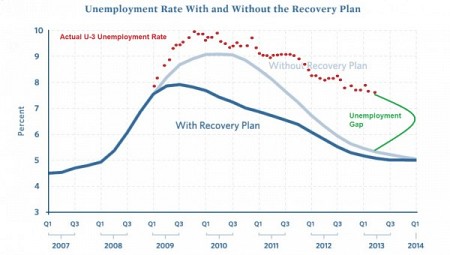
Did Obama Really Prevent A Second Great Depression?
...IBD reviewed records of economic forecasts made just before Obama signed the stimulus bill into law, as well as economic data and monthly stimulus spending data from around that time, and reviews of the stimulus bill itself.
The conclusion is that in claiming to have staved off a Depression, the White House and its supporters seem to be engaging in a bit of historical revisionism.
Economists weren't predicting a Depression.
White House economists forecast in January 2009 that, even without a stimulus, unemployment would top out at just 8.8% — well below the 10.8% peak during the 1981-82 recession, and nowhere near Depression-era unemployment levels.
The same month, the Congressional Budget Office predicted that, absent any stimulus, the recession would end in "the second half of 2009." The recession officially ended in June 2009, suggesting that the stimulus did not have anything to do with it....
...IBD reviewed records of economic forecasts made just before Obama signed the stimulus bill into law, as well as economic data and monthly stimulus spending data from around that time, and reviews of the stimulus bill itself.
The conclusion is that in claiming to have staved off a Depression, the White House and its supporters seem to be engaging in a bit of historical revisionism.
Economists weren't predicting a Depression.
White House economists forecast in January 2009 that, even without a stimulus, unemployment would top out at just 8.8% — well below the 10.8% peak during the 1981-82 recession, and nowhere near Depression-era unemployment levels.
The same month, the Congressional Budget Office predicted that, absent any stimulus, the recession would end in "the second half of 2009." The recession officially ended in June 2009, suggesting that the stimulus did not have anything to do with it....
Saturday, May 28, 2011
Carter: Economic Stagnation Explained, at 30,000 Feet
The man in the aisle seat is trying to tell me why he refuses to hire anybody. His business is successful, he says, as the 737 cruises smoothly eastward. Demand for his product is up. But he still won’t hire.
“Why not?”
“Because I don’t know how much it will cost,” he explains. “How can I hire new workers today, when I don’t know how much they will cost me tomorrow?”
He’s referring not to wages, but to regulation: He has no way of telling what new rules will go into effect when. His business, although it covers several states, operates on low margins. He can’t afford to take the chance of losing what little profit there is to the next round of regulatory changes. And so he’s hiring nobody until he has some certainty about cost. ...
The man in the aisle seat is trying to tell me why he refuses to hire anybody. His business is successful, he says, as the 737 cruises smoothly eastward. Demand for his product is up. But he still won’t hire.
“Why not?”
“Because I don’t know how much it will cost,” he explains. “How can I hire new workers today, when I don’t know how much they will cost me tomorrow?”
He’s referring not to wages, but to regulation: He has no way of telling what new rules will go into effect when. His business, although it covers several states, operates on low margins. He can’t afford to take the chance of losing what little profit there is to the next round of regulatory changes. And so he’s hiring nobody until he has some certainty about cost. ...
Sunday, May 22, 2011
Wall Street: Not Guilty
Why have no executives gone to jail for their roles in the financial crisis? Perhaps because risk-taking and stupidity aren't criminal
...Taken from the top, these sentiments imply that the financial crisis was caused by fraud; that people who take big risks should be subject to a criminal investigation; that executives of large financial firms should be criminal suspects after a crash; that public revulsion indicates likely culpability; that it is inconceivable (to Madoff, anyway) that people could lose so much money absent a conspiracy; and that Wall Street bears collective guilt for which a large part of it should be incarcerated.
These assumptions do violence to our system of justice and hinder our understanding of the crisis. The claim that it was "caused by financial fraud" is debatable, but the weight of the evidence is strongly against it. The financial crisis was accompanied by fraud, on the part of mortgage applicants as well as banks. It was caused, more nearly, by a speculative bubble in mortgages, in which bankers, applicants, investors, and regulators were all blind to risk. More broadly, the crash was the result of a tendency in our financial culture, especially after a period of buoyancy, to push leverage and risk-taking to the extreme.
Mortgage fraud exacerbated the bubble—as did, among other factors, lax monetary policy, failure by Congress and successive administrations to rein in Fannie Mae (FNMA) and Freddie Mac (FMCC), and weak financial regulation, itself a product of the discredited but entrenched thesis that markets are efficient and self-policing. At the banks, overconfidence in "risk management" methods (which were mostly worthless) and ill-considered compensation practices were serious contributing causes.
As this list suggests, the meltdown was multi-causal. That explanation will be unsatisfying to armchair prosecutors, but it has the virtue of answering to the complex nature of the bubble. To prosecute white-collar crime is right and proper, and a necessary aspect of deterrence. But trials are meant to deter crime—not to deter home foreclosures or economic downturns. And to look for criminality as the supposed source of the crisis is to misread its origins badly. ...
Why have no executives gone to jail for their roles in the financial crisis? Perhaps because risk-taking and stupidity aren't criminal
...Taken from the top, these sentiments imply that the financial crisis was caused by fraud; that people who take big risks should be subject to a criminal investigation; that executives of large financial firms should be criminal suspects after a crash; that public revulsion indicates likely culpability; that it is inconceivable (to Madoff, anyway) that people could lose so much money absent a conspiracy; and that Wall Street bears collective guilt for which a large part of it should be incarcerated.
These assumptions do violence to our system of justice and hinder our understanding of the crisis. The claim that it was "caused by financial fraud" is debatable, but the weight of the evidence is strongly against it. The financial crisis was accompanied by fraud, on the part of mortgage applicants as well as banks. It was caused, more nearly, by a speculative bubble in mortgages, in which bankers, applicants, investors, and regulators were all blind to risk. More broadly, the crash was the result of a tendency in our financial culture, especially after a period of buoyancy, to push leverage and risk-taking to the extreme.
Mortgage fraud exacerbated the bubble—as did, among other factors, lax monetary policy, failure by Congress and successive administrations to rein in Fannie Mae (FNMA) and Freddie Mac (FMCC), and weak financial regulation, itself a product of the discredited but entrenched thesis that markets are efficient and self-policing. At the banks, overconfidence in "risk management" methods (which were mostly worthless) and ill-considered compensation practices were serious contributing causes.
As this list suggests, the meltdown was multi-causal. That explanation will be unsatisfying to armchair prosecutors, but it has the virtue of answering to the complex nature of the bubble. To prosecute white-collar crime is right and proper, and a necessary aspect of deterrence. But trials are meant to deter crime—not to deter home foreclosures or economic downturns. And to look for criminality as the supposed source of the crisis is to misread its origins badly. ...
Saturday, May 21, 2011
GM's Profits are Still a Huge Net Loss For Taxpayers
...What lesson, exactly, are we supposed to learn from this "success"? What question did it answer? "Can the government keep companies operating if it is willing to give them a virtually interest free loan of $50 billion, and a tax-free gift of $20 billion or so?" I don't think that this was really in dispute. When all is said and done, we will probably have given them a sum equal to its 2007 market cap and roughly four times GM's 2008 market capitalization.
No, the question was not whether GM could make a profit after a bankruptcy that stiffed most of its creditors and shed the most grotesque burdens of its legacy costs, nor whether giving companies money will make them more profitable. The question is whether it was worth it to the taxpayer to burn $10-20 billion in order to give the company another shot at life. To put that in perspective, GM had about 75,000 hourly workers before the bankruptcy. We could have given each of them a cool $250,000 and still come out well ahead compared to the ultimate cost of the bailout including the tax breaks--and over $100,000 a piece if we just wanted to break even against our losses on the common stock. ...
GM Makes a Big Profit: Time to Celebrate?
...Okay, let's not get too excited here. GM sold off big stakes in Delphi (formerly its captive parts supplier) and Ally Financial (formerly its capital arm) to generate the bulk of that profit; the company's not making record money because it sold three times as many cars. GM is still excessively dependent on big incentives and fleet sales to move cars off of its lot, which means that despite quality enhancements made possible by the bankruptcy (which lowered fixed costs, and allowed them to put more money into making cars), their brand still hasn't recovered from decades of neglect. And while later in the post, Cohn makes it sound as if GM has suddenly turned itself into the world's premier small-car maker, it is still heavily dependent on the same old gas guzzling SUVs and trucks that have been shoring up GM profits for decades as foreign competitors steadily eroded their car sales. Right now in America, small cars are largely an economy business, which means that unless you can command the sort of quality premium that Toyota and Honda get--and I think the reliance on incentives shows that GM can't get that sort of markup--it's still very hard to make money in that space....
...What lesson, exactly, are we supposed to learn from this "success"? What question did it answer? "Can the government keep companies operating if it is willing to give them a virtually interest free loan of $50 billion, and a tax-free gift of $20 billion or so?" I don't think that this was really in dispute. When all is said and done, we will probably have given them a sum equal to its 2007 market cap and roughly four times GM's 2008 market capitalization.
No, the question was not whether GM could make a profit after a bankruptcy that stiffed most of its creditors and shed the most grotesque burdens of its legacy costs, nor whether giving companies money will make them more profitable. The question is whether it was worth it to the taxpayer to burn $10-20 billion in order to give the company another shot at life. To put that in perspective, GM had about 75,000 hourly workers before the bankruptcy. We could have given each of them a cool $250,000 and still come out well ahead compared to the ultimate cost of the bailout including the tax breaks--and over $100,000 a piece if we just wanted to break even against our losses on the common stock. ...
GM Makes a Big Profit: Time to Celebrate?
...Okay, let's not get too excited here. GM sold off big stakes in Delphi (formerly its captive parts supplier) and Ally Financial (formerly its capital arm) to generate the bulk of that profit; the company's not making record money because it sold three times as many cars. GM is still excessively dependent on big incentives and fleet sales to move cars off of its lot, which means that despite quality enhancements made possible by the bankruptcy (which lowered fixed costs, and allowed them to put more money into making cars), their brand still hasn't recovered from decades of neglect. And while later in the post, Cohn makes it sound as if GM has suddenly turned itself into the world's premier small-car maker, it is still heavily dependent on the same old gas guzzling SUVs and trucks that have been shoring up GM profits for decades as foreign competitors steadily eroded their car sales. Right now in America, small cars are largely an economy business, which means that unless you can command the sort of quality premium that Toyota and Honda get--and I think the reliance on incentives shows that GM can't get that sort of markup--it's still very hard to make money in that space....
Subscribe to:
Posts (Atom)